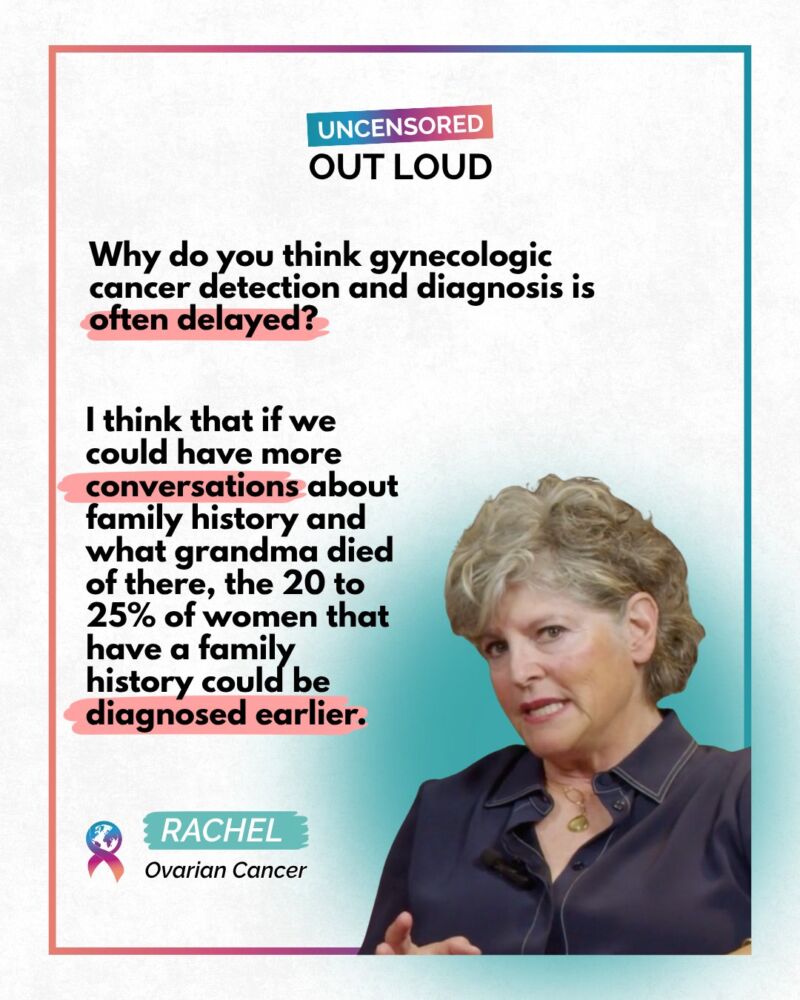

“Depression, even the most severe cases, can be treated.
The earlier treatment begins, the more effective it is.
Depression is usually treated with psychotherapy…”.1
Umbrella
What may the Depression Umbrella include?
Depending on the Source (DotS) this Umbrella may include:
- Black Dog
- Clinical Depression
- Depression
- Depression the Serious Clinical Illness
- Depressive Disorder/Episode/Illness
- Dysthymia
- Dysthymic Disorder
- Major Depression
- Major Depressive Disorder/Episode/Illness
- Minor Depression
- Nervous Breakdown
- Persistent Depressive Disorder (PDD)
- Unipolar Depression
Definition
What is depression?
DotS the definition of depression may vary. In Depressive Disorder (Depression): Overview the World Health Organization’s (WHO) definition is:
Sadness or Depression
Is sadness the same as depression?
In Depression In Women: 4 Things To Know the (United States) National Institute of Mental Health’s (NIMH) note:
Nervous Breakdown
Is a nervous breakdown the same as depression?
In Nervous Breakdown: What Does It Mean? What Does It Mean To Have A Nervous Breakdown? the (United States) Mayo Clinic explain:
Bipolar Disorder
Is bipolar disorder the same as depression?
DotS bipolar disorder may be described as a type of depression, however bipolar disorder is not the same as depression the serious illness or clinical depression. In Bipolar Disorder: What Is Bipolar Disorder? the NIMH’s definition is:
Mild, Moderate or Severe
How can depression be categorised?
In Depressive Disorder (Depression): Symptoms and Patterns the WHO explain:
Symptoms
What can symptoms of depression include?
In Depression: What Are the Symptoms of Depression? the (United States) MedlinePlus elaborate on:
 “Symptoms of depression are ongoing and affect your day-to-day life. They can include:
- Feeling sad or “empty”
- Losing interest in favorite activities
- Overeating, or not wanting to eat at all
- Sleeping too much, or not enough
- Feeling very tired
- Feeling hopeless, irritable, anxious, or guilty
- Having aches and pains, headaches, cramps, or digestive problems
- Having thoughts of death or suicide
- Changing moods or behaviors
- Increasing use of alcohol or drugs
- Isolating from family and friends”.7
Cause
What may cause depression?
The WHO explain:
Depression is closely related to, and affected by, physical health. Many of the factors that influence depression (such as physical inactivity or harmful use of alcohol) are also known risk factors for diseases such as cardiovascular disease, cancer, diabetes and respiratory diseases. In turn, people with these diseases may also find themselves experiencing depression due to the difficulties associated with managing their condition”.8
Common or Not
How common is depression?
Globally, according to statistics quoted by the WHO:
- “Depression is a common mental disorder.
- Globally, an estimated 5.2% of adults suffer from depression”.9
In the United States according to statistics quoted by the Anxiety and Depression Association of America (ADAA) in What Is Depression? Did You Know?:
- In 2017, around 17.3 million adults age 18 or older in the U.S. had experienced at least one major depressive episode in the last year (6.7% of adults in the U.S.)”.10
In England according to 2014 statistics quoted by the (United Kingdom) Mental Health Foundation in Depression:
Depression and Anxiety
Is there an association between depression and anxiety?
In What Is Depression? Depression and Anxiety: What’s the Difference? the ADAA explain:
People with depression may also feel:
- Nervous or tense
- Irritable
- Unable to sleep
- Unable to focus
Having anxiety earlier in life can make depression more likely later, but one does not directly “cause” the other.12
Treatment
How can depression be treated?
In Depression In Women: 4 Things To Know – 4. You Can Get Help for Depression the NIMH elaborate on:
In In Depression In Women: 4 Things To Know – 4. You Can Get Help for Depression the NIMH also include:
Health Care Provider
What if I think I have depression?
If you think you have depression, it may be in your best interest to choose to talk to your health care provider about this urgently.
In Depression In Women: 4 Things To Know – 1. Depression Is A Medical Condition the NIMH explain:
“Depression is not brought on by anything a woman has or has not done, and it is not something she can “snap out” of. Most women need treatment to feel better”.15
In Find A Mental Health Professional: What Are Mental Health Professional Services? Finding the Right Professional for You the (Australian) Beyondblue note:
Health Topics A-Z
Where may I find Health Topics A-Z related to Depression
In Health Topics A-Z you may find:
Links
Where may I find Links related to Depression?
Your Country may have Links similar to:
Links
This Links List to third party websites is neither comprehensive nor exhaustive. Inclusion on this Links List does not imply endorsement or recommendation. Non-inclusion on this Links List does not imply non-endorsement or non-recommendation. Third party websites are not under the control of Meno Martha International Menopause Directory. Third party websites may contain explicit medical images and/or sexual references. Please read Meno Martha International Menopause Directory’s Links Policy before proceeding to a Link. Please contact Webmaster if you experience a problem with a Link.New or Updated
- Emerging Topics In Women’s Health: Minding the Depression Gap [01 May 2025]
- Hormones & Mental Health: What Every Woman Needs To Know | Live With Dr Louise Newson [July 2025]
- Is It Menopause or Depression? How To Recognize the Differences and Find Relief [30 August 2026]
- Moderate Exercise Linked To Lower Depression Risk [24 April 2024]
- PMS and PMDD: Live Q&A With Dr Louise Newson [July 2025]
- Rethinking Mental Health and Antidepressant Prescribing [15 February 2026]
- Understanding Situational Depression [11 July 2025]
- Adaa.org [Anxiety and Depression Association of America]
- Alcohol and Stress
- Antidepressants
- Anxiety Disorders
- Anxiety vs. Depression: Which Do I Have (or Is It Both)?
- Anxietyuk.org.uk
- Beyondblue.org.au [Beyond Blue, Australia]
- Bipolar Disorder
- Bipolar Disorder
- Blackdoginstitute.org.au [Black Dog Institute, Australia]
- Boost Your Mood With Mind-Nourishing Food
- Can Massage Relieve Symptoms of Depression, Anxiety and Stress?
- Commonly Prescribed Antidepressants and How They Work
- Depression
- Depression
- Depression
- Depression (Major Depressive Disorder) [+ Video Courtesy: Mayo Clinic News Network]
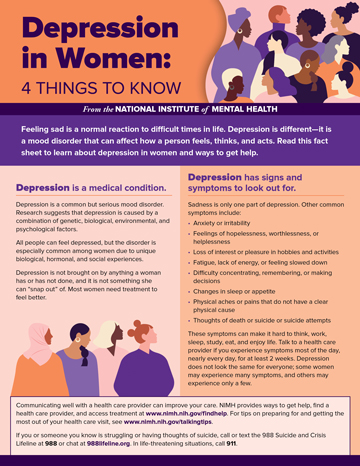 Depressive Disorder (Depression)
- Depression In Adults
- Depression In Women: 4 Things To Know
- Depression [+ Video: What Is Depression?]
- Depression – Multiply Languages
- Depressioncenter.org
- Diet and Mental Health
- Does Caffeine Make Depression Worse?
- Emerging Topics In Women’s Health: Minding the Depression Gap
- Exercise for Depression
- Exercise for the Treatment of Depression
- Exercising Your Way Out of Depression
- Feeling Lonely
- Feeling Stuck? Brainspotting May Help
- Find Help: Finding Help Is the Key To Taking Charge and Moving Forward
- Finding A Mental Health Professional
- Getting Help [United Kingdom]
- Headstogether.org.uk [Heads Together, United Kingdom]
- Help From Health Professionals
- Help for Mental Illnesses [United States]
- Hormones & Mental Health: What Every Woman Needs To Know | Live With Dr Louise Newson
- How Can You Find Joy (or At Least Peace) During Difficult Times?
- How Do I Know If I Have A Mental Health Problem? [Video]
- How Mindfulness Meditation Improves Mental Health
- How Do I Know If I Have A Mental Health Problem? [Video]
- How To Cope With Empty Nest Syndrome
- How To Look After Your Mental Health
- How To Look After Your Mental Health Using Exercise
- How To Manage and Reduce Stress
- How To Sleep Better
- If You or Someone You Know Is In Crisis and Needs Immediate Help
- International Association for Premenstrual Disorders
- Is It Menopause or Depression? How To Recognize the Differences and Find Relief
- Is There A link Between Pain and Depression?
- Ketamine for Treatment-Resistant Depression: When and Where Is It Safe?
- Later Years (Around 50 Years and Over): Menopause and Post Menopause Health – Menopause and Your Mental Wellbeing [+ Video: Menopause Only Affects You Physically!] [Other Languages and Formats]
- Mastering Midlife Mood Changes With Marlene Freeman, MD
- Mayo Clinic Minute: Prescribing Nature for Mental, Physical Health [+ Video Courtesy: Mayo Clinic News Network]
- Mayo Clinic Q and A: Countdown To Control Anxiety
- Mayo Clinic Q and A: How To Support A Loved One With Depression
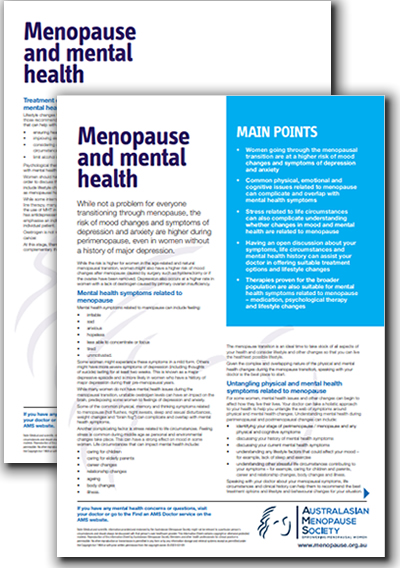
- Menopause and Mental Health
 Mental Health
- Mentalhealth.org.uk
- Mentalhealthatwork.org.uk [Mental Health At Work, United Kingdom]
- Mhanational.org [Mental Health America]
- Mind.org.uk
- Mindfulness
- Mindspot.org.au
- Moderate Exercise Linked To Lower Depression Risk
- Moodgym.com.au
- Mycompass.org.au
- Nami.org [NAMI: National Alliance on Mental Illness]
- National Center for Complementary and Integrative Health: Depression
- National Center for Complementary and Integrative Health: Herbs At A Glance
- National Center for Complementary and Integrative Health: How Safe Is This Product or Practice?
- National Center for Complementary and Integrative Health: Valerian
- National Institute of Mental Health: Depression
- Nervous Breakdown: What Does It Mean?
- Office of Dietary Supplements: Vitamin B6
- PMD Awareness Month [April]
- PMS and PMDD: Live Q&A With Dr Louise Newson
- SAMHSA.org: Find Help & Support [Substance Abuse and Mental Health Services Administration]
- SAMe
- Seasonal Affective Disorder (SAD)
- Seasonal Depression (Seasonal Affective Disorder)
- Self-Care Tips To Manage Mental Health and Wellness
- Talk With Your Doctor About Depression
- Top Tips To Improve Your Mental Wellbeing
- Treatment-Resistant Depression: What We Know and How To Manage It
- Understanding Situational Depression
- What Is Depression? Types of Depression
- What To Do When You Feel Depressed?
- What Is Cognitive Behavioral Therapy?
- What Is High-Functioning Depression? Signs and Symptoms
- Why Depression In Women Is So Misunderstood
Sources
Where may I find the Sources quoted?
You may find the Sources quoted at:
Sources
- Depression In Women: 4 Things To Know – 4. You Can Get Help for Depression. Revised: 2023. National Institute of Mental Health https://www.nimh.nih.gov/health/publications/depression-in-women Accessed: 12 September 2026
- Depressive Disorder (Depression): Overview. 11 September 2026. World Health Organization https://www.who.int/en/news-room/fact-sheets/detail/depression Accessed: 12 September 2026
- Depression In Women: 4 Things To Know. Revised: 2023. National Institute of Mental Health https://www.nimh.nih.gov/health/publications/depression-in-women Accessed: 12 September 2026
- Nervous Breakdown: What Does It Mean? What Does It Mean To Have A Nervous Breakdown? 26 April 2023. Mayo Clinic https://www.mayoclinic.org/diseases-conditions/depression/expert-answers/nervous-breakdown/faq-20057830 Accessed: 12 September 2026
- Bipolar Disorder: What Is Bipolar Disorder? Last Reviewed: December 2024. National Institute of Mental Health https://www.nimh.nih.gov/health/topics/bipolar-disorder Accessed: 12 September 2026
- Depressive Disorder (Depression): Symptoms and Patterns. 11 September 2026. World Health Organization https://www.who.int/en/news-room/fact-sheets/detail/depression Accessed: 12 September 2026
- Depression: What Are the Symptoms of Depression? Last Updated: 30 June 2025. MedlinePlus https://medlineplus.gov/depression.html Accessed: 12 September 2026
- Depressive Disorder (Depression): Contributing Factors and Prevention. 11 September 2026. World Health Organization https://www.who.int/en/news-room/fact-sheets/detail/depression Accessed: 12 September 2026
- Depressive Disorder (Depression): Key Facts. 11 September 2026. World Health Organization https://www.who.int/en/news-room/fact-sheets/detail/depression Accessed: 12 September 2026
- What Is Depression? This Page Was Updated: 22 December 2025. Anxiety and Depression Association of America https://adaa.org/understanding-anxiety/depression Accessed: 18 January 2026
- Depression. Last Updated 18 February 2022. Mental Health Foundation https://www.mentalhealth.org.uk/explore-mental-health/a-z-topics/depression Accessed: 12 September 2026
- What Is Depression? Depression and Anxiety: What’s the Difference? This Page Was Updated: 22 December 2025. Anxiety and Depression Association of America https://adaa.org/understanding-anxiety/depression Accessed: 12 September 2026
- Depression In Women: 4 Things To Know – 4. You Can Get Help for Depression. Revised: 2023. National Institute of Mental Health https://www.nimh.nih.gov/health/publications/depression-in-women Accessed: 18 January 2026
- Depression In Women: 4 Things To Know – 4. You Can Get Help for Depression. Revised: 2023. National Institute of Mental Health https://www.nimh.nih.gov/health/publications/depression-in-women Accessed: 18 January 2026
- Depression In Women: 4 Things To Know – 1. Depression Is A Medical Condition. Revised: 2023. National Institute of Mental Health https://www.nimh.nih.gov/health/publications/depression-in-women Accessed: 18 January 2026
- Find A Mental Health Professional: What Are Mental Health Professional Services? Finding the Right Professional for You https://www.beyondblue.org.au/get-support/find-a-mental-health-professional Accessed: 18 January 2026
Topic Last Updated: 12 September 2026 – Topic Last Reviewed: 18 January 2026